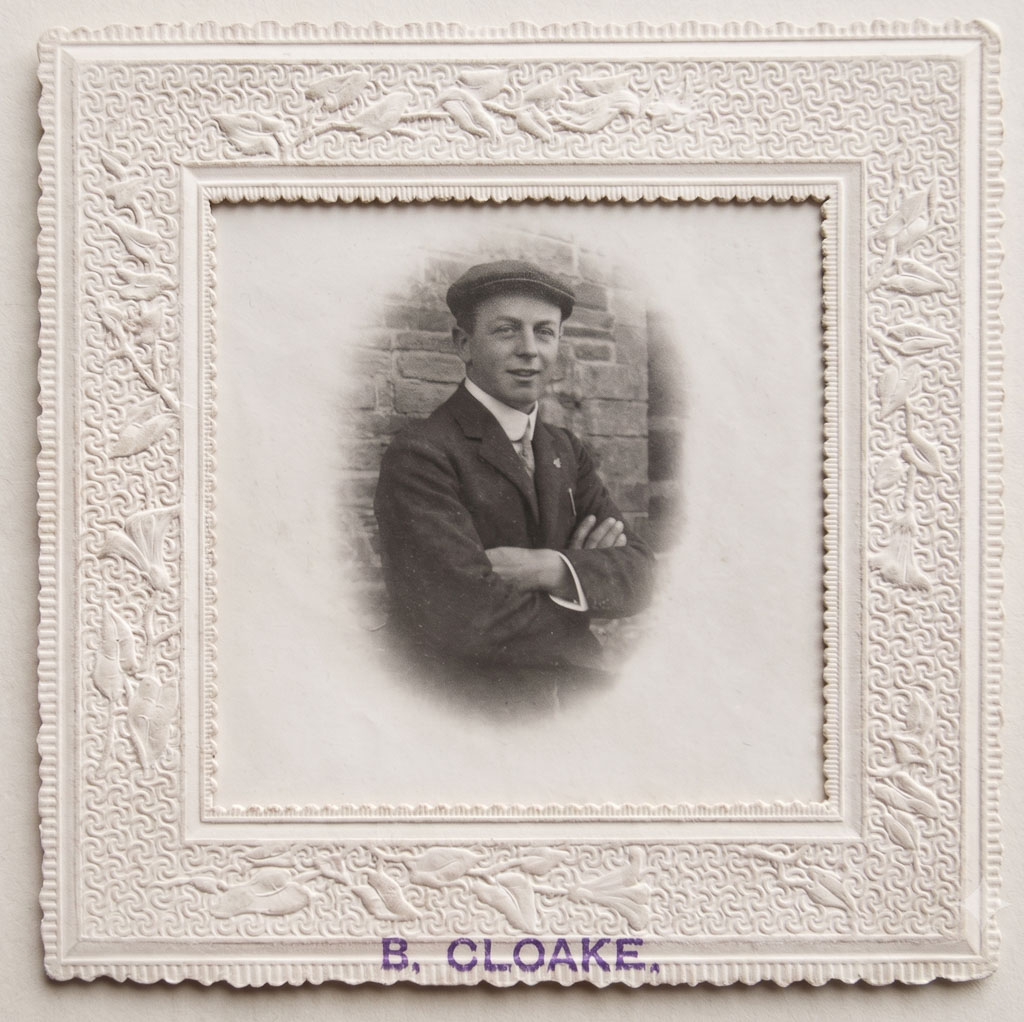
In the early 1900s, working-class photography carried an immense material burden. Every exposure represented an irreversible investment of hard-earned wages spent on chemically treated plates and specialized developers. Bertie spent his youth mastering the delicate triangulation of light, optics, and spatial geometry. This formative portfolio, though created initially for personal satisfaction, functioned as a strict technological training ground. He was training his eye to operate with complete premeditation. The uncompromising standard of visual perfection that defined his later years was not born out of aesthetic pretense; it was an inherited piece of Cornish artisan discipline, packed securely into his luggage when the dream of a farming life beckoteamned him overseas to New Zealand.
Bertie as a teenage self-photographer - Bag Mill, Cornwall
II. High-Country Logistics: Isolation, Remoteness, and Travel
The transition from the tight, urban geography of the West Country to the immense scale of the South Island introduced a level of environmental and logistical friction that completely reshaped Bertie’s practice. As documented in Mary’s Story, the his journey from the moment he disembarked the S.S. Corinthic in 1912 was defined by unrelenting mobility and isolation, shifting through distinct high-country runs and hinterland farms before finally establishing a permanent foothold at Springbrook in 1921.
Operating a large-format photographic operation under these conditions was a monumental logistical feat. At times he lived with his family in deep geographical isolation, dealing with primitive backcountry quarters where hot water bottles froze solid inside winter beds and deep alpine snows cut off all physical communication for weeks at a time. In this environment, photographic materials were not commercial conveniences; they were precious, finite resources that had to be ordered months in advance from urban merchants in distant cities, shipped via rail to Fairlie, and hauled inland over barely-formed mountain passes.
Coach stop at Tekapo
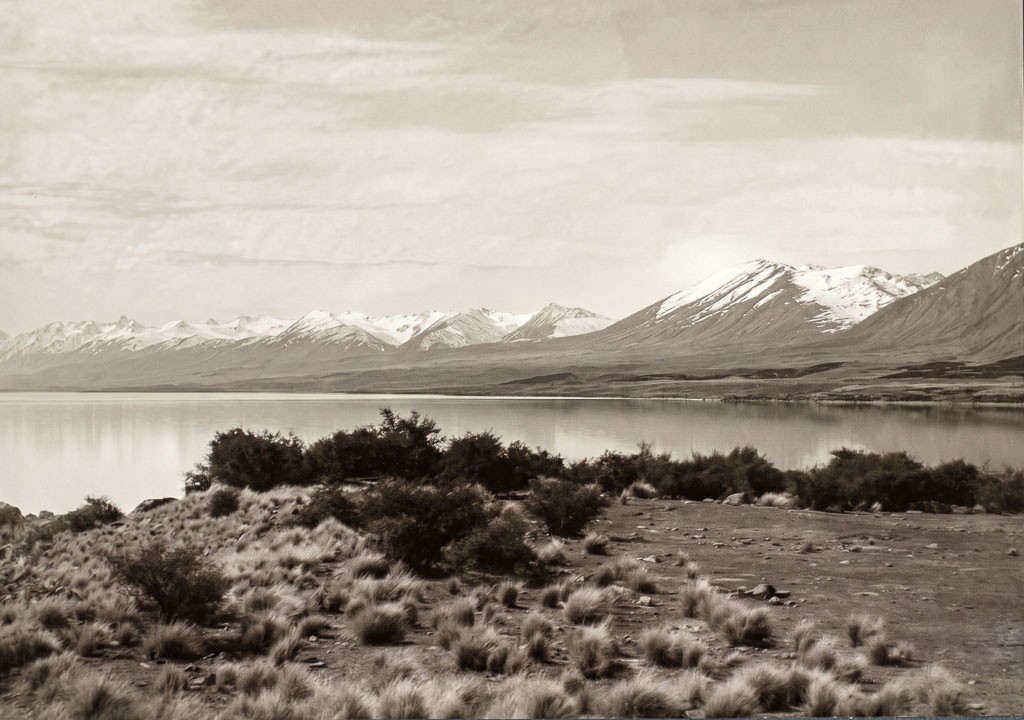
Lake Tekapo foreshore
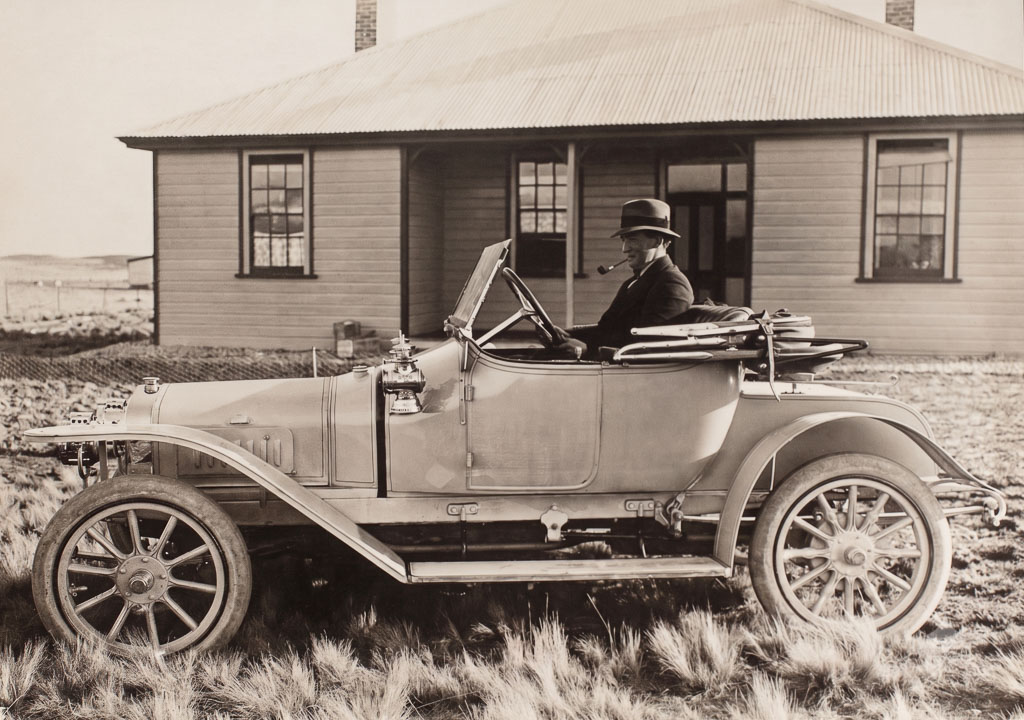
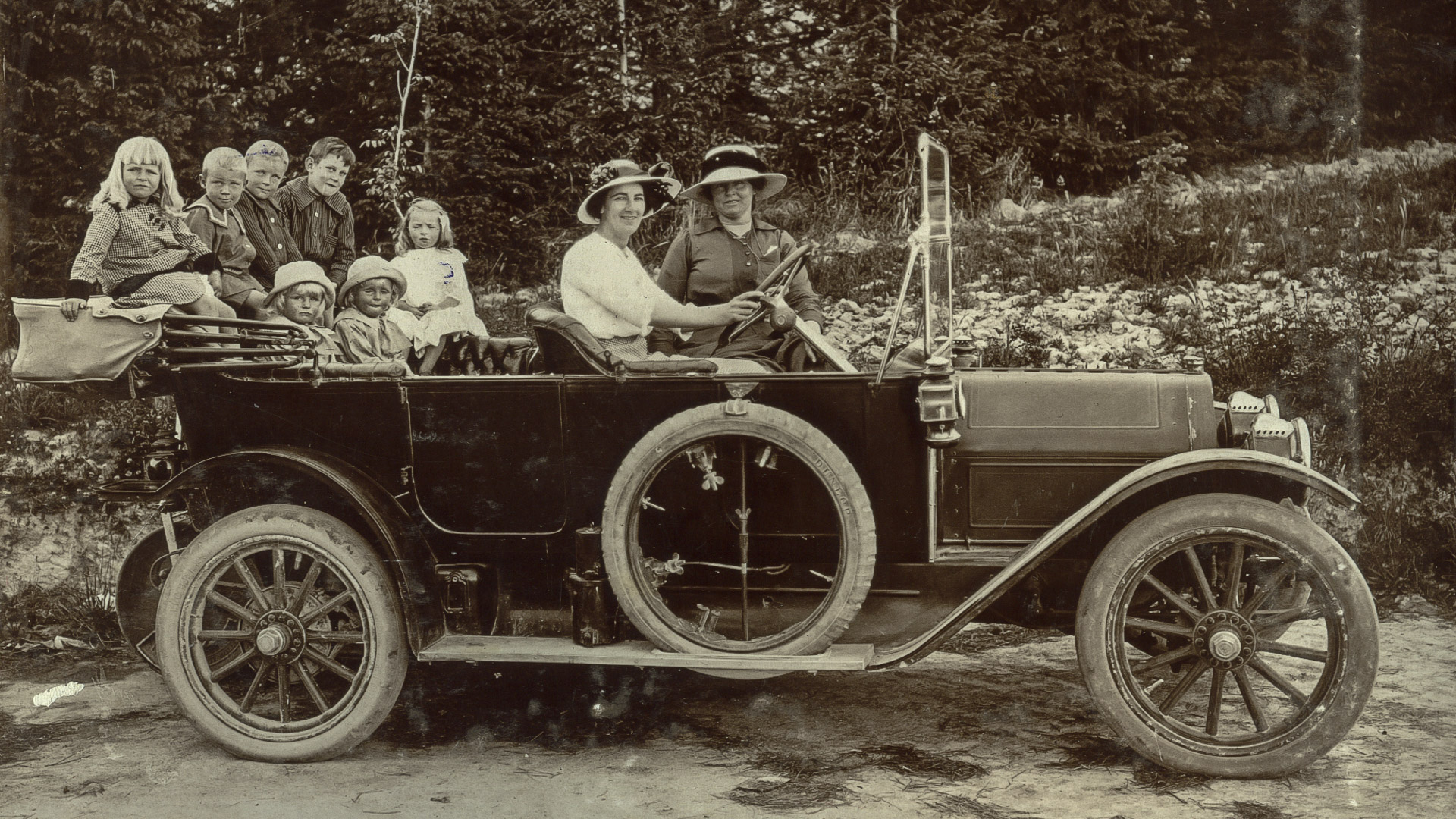
The physical reality of travel posed a constant threat to the archive. To capture his images, Bertie had to transport a fragile ecosystem of glass plates, volatile chemical toning solutions, and a bulky half-plate mahogany camera over rough tracks. The primary modes of transport—horse-drawn drays, backcountry coaches, and packhorses—subjected the equipment to violent, structural vibrations. Cars were few and far between! A single dropped crate or a poorly secured pack meant the total destruction of imported glass plate stock that could take months to replace. This extreme isolation altered the psychological value of the camera. The physical labor of hauling the gear was sustained by a deep necessity to document their survival in a vast, foreign landscape that was completely indifferent to their presence.
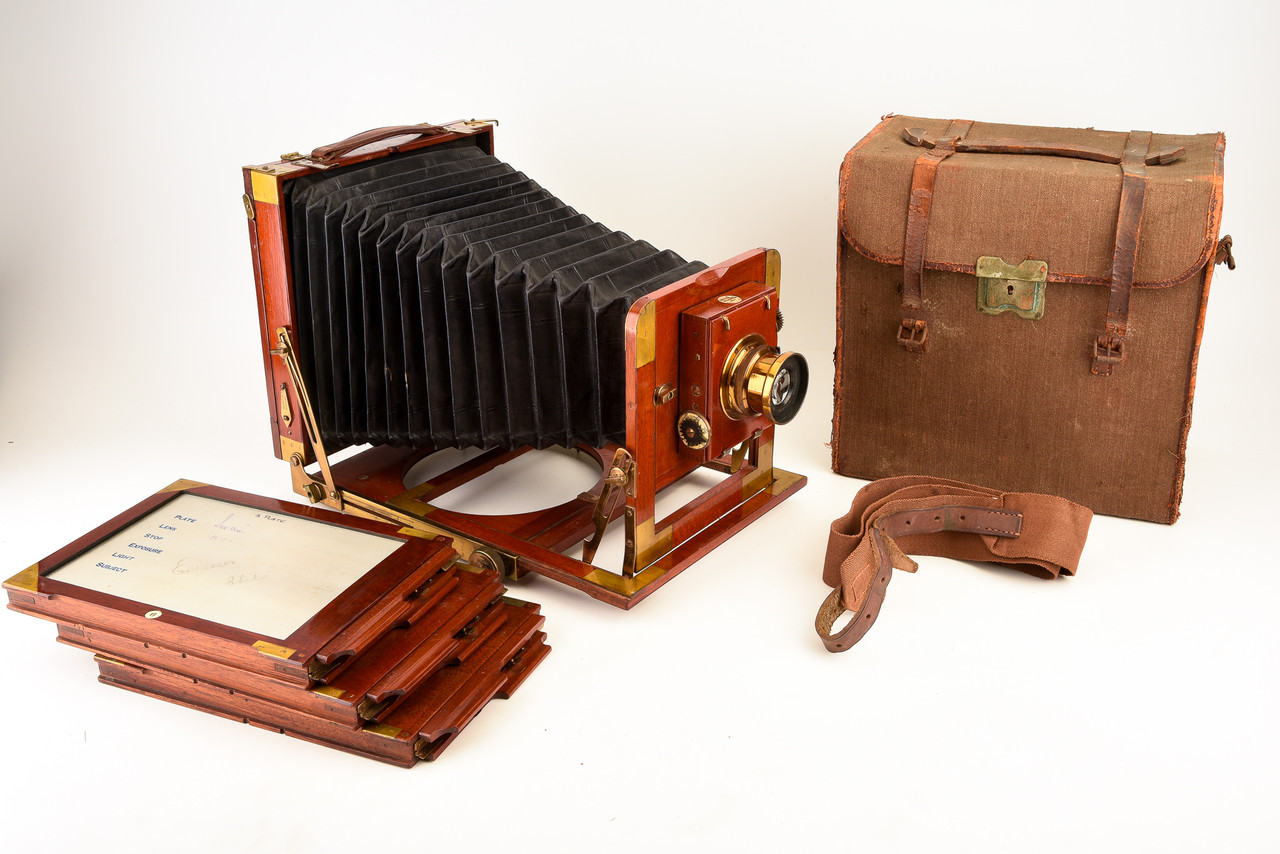
The Tool of the Dispatches: Bertie's extant British-made Thornton-Pickard half-plate field camera system (c. 1910), constructed from polished mahogany and lacquered brass with folding leather bellows. Preserved in original mechanical condition within Geoff's hardware collection, this apparatus served as the primary visual engine documenting the family’s migration from Cornwall and their subsequent movements through various remote South Canterbury high-country runs and lowland farms between 1912 and 1922.
Visible technical features include the complex front and back standard movements (rise, fall, tilt, and swing struts) which allowed Bertie Cloake, for example, capture sprawling multi-horse working hitch teams without edge-to-edge optical fall-off or perspective distortion. Mounted immediately behind the brass barrel lens is the iconic Thornton-Pickard "Time & Instantaneous" roller-blind shutter box. Actuated via a pneumatic rubber bulb, its spring-tensioned internal fabric curtain achieved speeds of roughly 1/90th of a second—swift enough to freeze moving draft horses and flying silt in the high-wind environments of Meikleburn and Irishman’s Creek.
Resting alongside the camera chassis are the interlocking mahogany double-darkslides. Holding only two glass dry plates (6.5x4.75 inches) back-to-back, the inventory of exactly six surviving slides enforced a strict limit of twelve exposures per field trip. This material capacity limit drove the extreme pre-visualisation and deliberate precision that anchors the origin of the family's century-long photographic lineage.
III. Hauling a Studio Into the Wilds of South Canterbury
By the time Bertie was documenting life on remote runs like Irishman’s Creek, Simons Pass and later, Meikleburn, the technological baseline of his Cornish craft had adapted to meet these environmental demands. The British-made Thornton-Pickard half-plate field camera was a heavy, uncompromising professional apparatus. Built from solid, polished mahogany and detailed with lacquered brass struts and gears, it demanded time and precision to secure an exposure.
Operating this field studio amidst the chaotic, high-wind environments of the Mackenzie and Fairlie basins required immense physical resilience. Bertie had to manually level a heavy wooden tripod in shifting loose shale, submerge himself beneath a black velvet drape to evaluate an upside-down composition on the ground-glass screen, and utilize the camera's complex mechanical movements. By shifting, rising, or tilting the lens panel relative to the glass back, he could alter the plane of focus—applying the Scheimpflug principle to keep an entire eight-horse working hitch needle-sharp from the lead animals' blinkers back to the dust-covered teamster on the wagon.
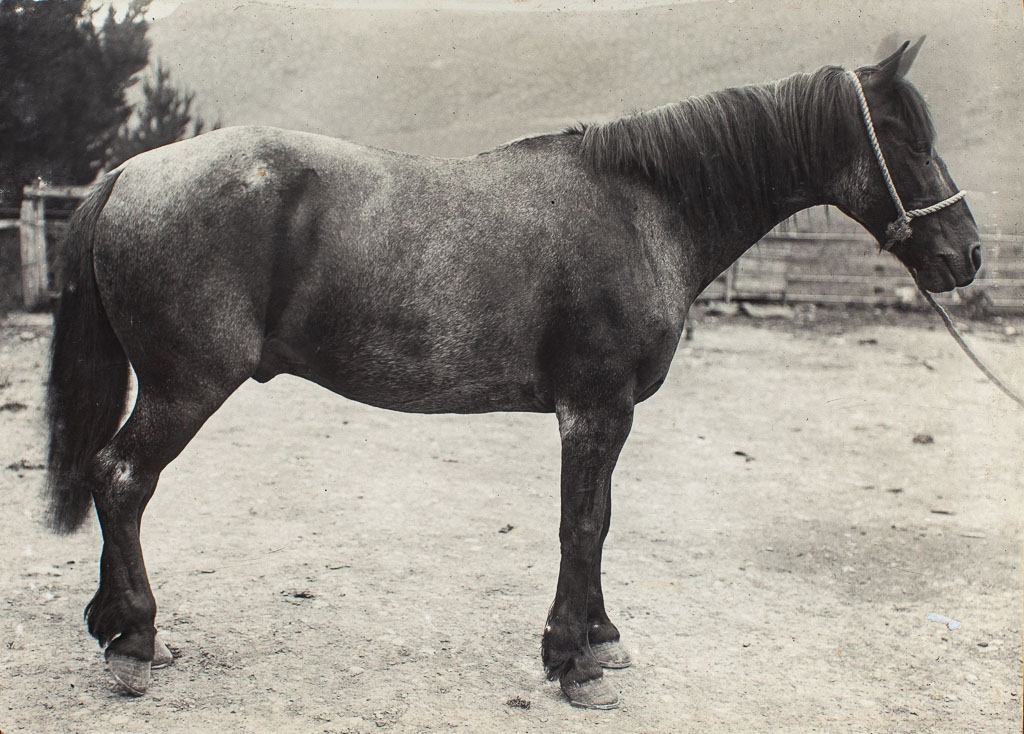
One of the team
This painstaking routine was driven by a harsh logistical capacity limit. Carrying an inventory of exactly six mahogany double-darkslides, Bertie had a strict limit of twelve exposures per field trip before requiring absolute darkness to swap plates. Casual experimentation did not exist. Every single squeeze of the pneumatic rubber shutter bulb was a calculated act of faith, timed perfectly to freeze moving draft teams and blowing silt at roughly 1/90th of a second.
Irishman Creek Station
IV. Chemistry in the Station Hut: The Solar Dispatches
The physical transformation of his glass exposures into permanent artifacts took place inside the drafty, isolated quarters of high-country outstations, far removed from urban darkrooms. Bertie would have relied on factory-pre-coated gelatin dry plates, which could sit light-tight inside his mahogany slides for weeks without degrading. At night, working purely by touch or under the dim, volatile glow of a ruby oil safe-lamp, he would reload his six darkslides, packing the exposed glass safely into grooved storage boxes. These fragile plates survived journeys because the mahogany slides featured deep interlocking tongue-and-groove joints and internal spring dividers that kept the glass plates perfectly flush, preventing fracturing and emulsion abrasion during transit.
To communicate their survival to loved ones waiting in the West Country, Bertie utilized Gelatin Printing-Out Paper (POP) pre-cut to postcard size. Clamping the developed glass negative directly against the paper emulsion within a split-back wooden printing frame, he stepped out into the bright South Canterbury sun. The image literally "printed out" before his eyes, darkening via pure solar radiation without chemical developing agents.
To lock the silver image against fading, he treated the prints in a gold chloride toning bath. The gold atoms chemically replaced the unstable silver, transforming the raw, fiery orange-red tones of the sun-exposure into a permanent, chemically stable chocolate- or purple-brown hue. Fixed in sodium thiosulfate ("hypo") and washed thoroughly in mountain creek water, these cards were robust enough to survive the long steamship mail route back to the UK. Placed on the mantels of the Cloake, Hocking, Braund, and Zorgdrager families, they provided an undeniable visual ledger of success. They showed infants Mary, Harry and Myra growing up in the hills, and brother Arthur Bernard Cloake (Snr) steering a five-horse team through the Meikleburn soils while still proudly wearing his traditional Cornish working-class tweed flat cap.
V. The Commemorative Ledger and the Missing Record
Bertie’s technical precision quickly expanded his role beyond that of a private family documentarian. In the remote, rural valleys of South Canterbury, an individual who possessed a working mastery of a half-plate field camera was a rare and valuable asset. Consequently, Bertie’s photographic practice experienced a semi-professional crossover. He must have at times undertaken uncredited portrait commissions, commemorative station line-ups, and formal family group photos for high-country neighbors, co-workers, and visiting station staff who wished to preserve their own milestones.
The McKeowan family
Because these formal portrait prints were distributed locally across various Canterbury homesteads or sent directly to independent family branches in England, a significant portion of this early operational ledger remains uncataloged within the immediate family collection. While the physical hardware heritage—the mahogany Thornton-Pickard chassis and its six original slides—is preserved by Geoff Cloake, the primary vintage print albums remain under the stewardship of Mervyn Cloake.
Piecing together the full scale of Bertie's early work remains a collaborative family puzzle. By leveraging casual opportunities with UK-based relations to locate original solar postcards, and utilizing rapid, mobile smartphone reference captures by a third generation—such as Bertie's great-granddaughter Annelies during her Cornwall visit—the family continues to reconstruct this visual line of custody. It stands as a testament to an immigrant's uncompromising discipline, capturing a raw era of rural New Zealand history through a highly particular eye. It forms the definitive opening chapter of a century-long, intergenerational continuum of photographic practice that continues to document the changing landscapes of Aotearoa.