The Last Works of William Hambly
An 1835 Callington Time Capsule: One Watchmaker's Swan Song and the 190-Year Journey of a Family Heirloom
This silver pair-cased Verge Fusee pocket watch represents a rare survival of Cornish watchmaking at a pivotal moment in history. Signed by William Hambly of Callington and hallmarked in 1835, this timepiece emerged from a workshop that would close within months of its creation. Today, 190 years later, it rests with Mervyn Cloake—a tangible connection to five generations of family history and the lost world of provincial English horology.
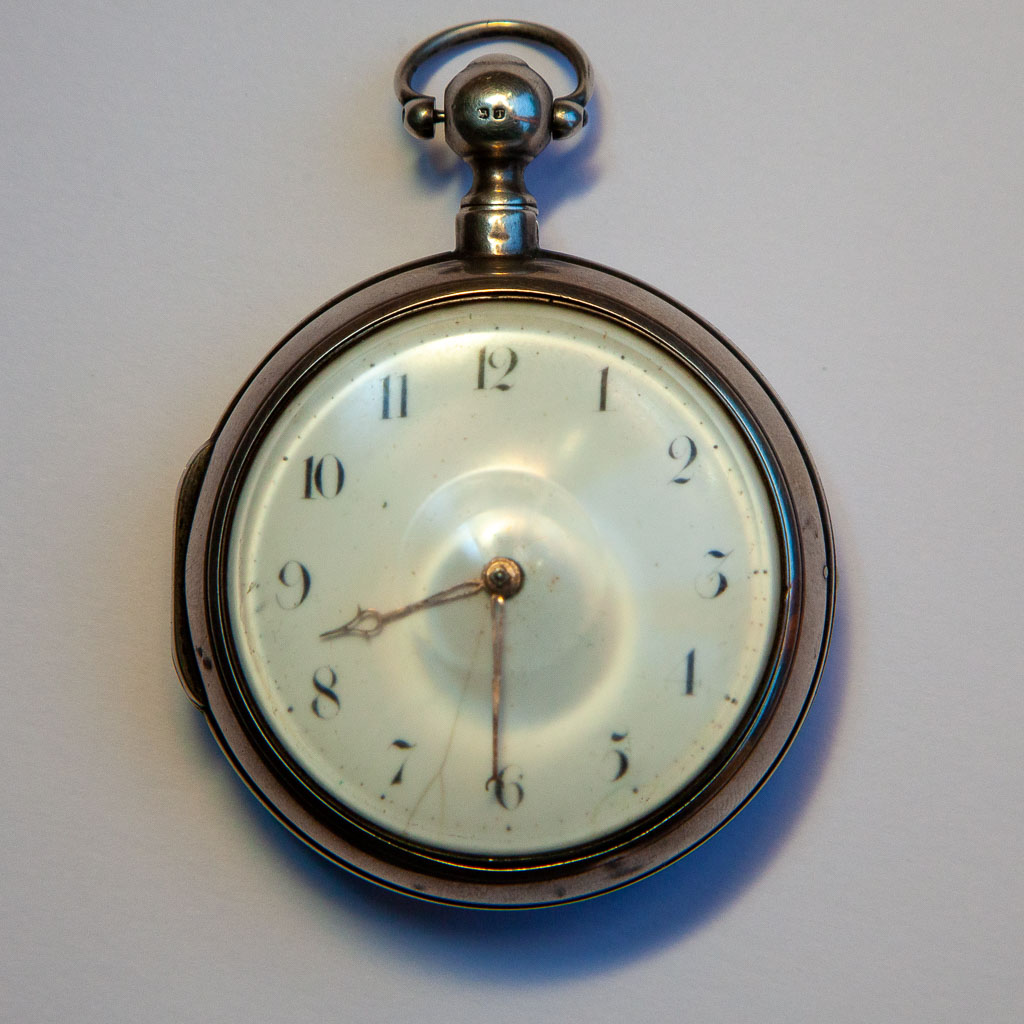
William Hambly: A Callington Craftsman's Final Chapter
Historical records indicate that William Hambly died in October 1835. The hallmarks inside this watch case date the silver specifically to the period between August 1835 and August 1836—placing this timepiece among the very last works ever assembled or sold by Hambly's workshop.
This is a watchmaker's "swan song": the final products of a lifetime's trade, bearing Hambly's signature and workshop number even as his business approached its end. Whether Hambly himself performed the final assembly and regulation, or whether the piece was completed by family or apprentices after his death in October, we cannot know with certainty. What is clear is that this watch represents the closing chapter of independent watchmaking in Callington.
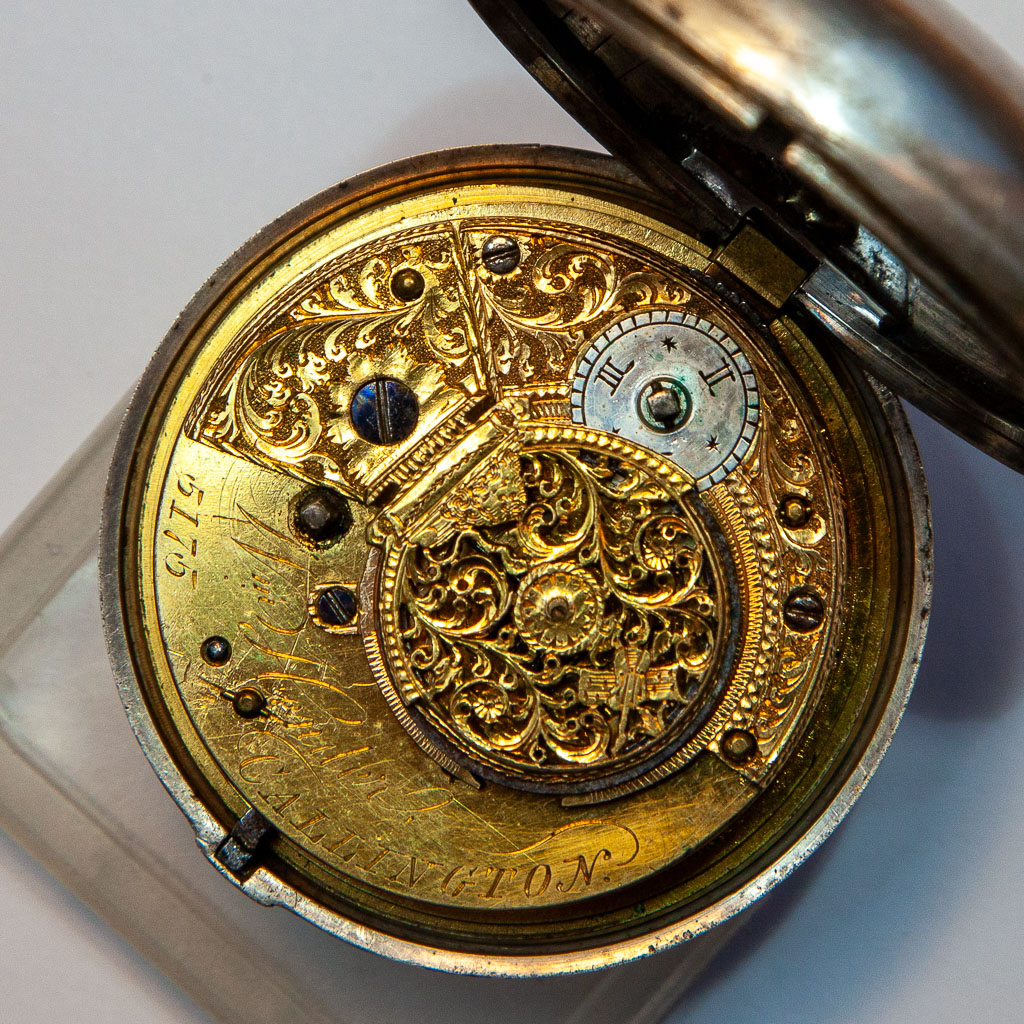
The movement bears the signature "Wm. Hambly, Callington, No. 5175"—suggesting that Hambly's workshop had produced thousands of timepieces over his career. The ornate hand-engraved balance cock, with its intricate floral scrollwork and grotesque mask (a traditional apotropaic symbol meant to ward off evil), demonstrates the level of craftsmanship that provincial watchmakers brought to their trade.
The 19th-Century Supply Chain: A Global Effort
While this watch proudly bears Hambly's signature and "Callington" on its dial, its creation illustrates the sophisticated supply chain that characterized British watchmaking in the 1830s. This was not the work of a single craftsman, but rather the orchestration of specialized skills from across England.
The Journey from Raw Materials to Finished Timepiece
The raw movement (called an ébauche) was likely machined in Prescot, the center of English rough movement manufacturing. Prescot's workshops mass-produced the basic plates, wheels, and components using water-powered machinery and specialized tooling. These rough movements were shipped throughout England to be finished by local watchmakers.
The sterling silver case was crafted by specialist silversmith John Gamon (maker's mark "IG") in Exeter, about 50 miles from Callington. Gamon would have formed the pair of cases from sheet silver, added hinges and catches, then taken them to the Exeter Assay Office for hallmarking. Only after receiving the official quality marks could the cases be legally sold.
The finishing, gilding, escapement fitting, and final regulation were performed by William Hambly in his Callington workshop. This is where the parts came to life—where a Lancashire mechanism and an Exeter case were transformed into a precision timepiece. Hambly would have:
- Gilded (gold-plated) the brass movement for corrosion resistance and beauty
- Hand-engraved the balance cock with its decorative flourishes
- Fitted and adjusted the Verge escapement for accuracy
- Regulated the watch to keep proper time
- Fitted the enamel dial (likely purchased from a specialist dial maker)
- Assembled all components into the cases
- Tested and certified the completed timepiece
This division of labor allowed for both quality and affordability. Prescot's machines could produce movement parts more precisely and cheaply than any single watchmaker. Exeter's specialist case makers could work silver more skillfully than a watchmaker. And Hambly could focus his expertise on the skilled work of finishing, regulating, and certifying—work that required years of training and a craftsman's touch.
Understanding the Hallmarks: Dating to 1835
The silver case bears five distinct hallmarks that tell us exactly when and where this watch entered the world of legitimate commerce.
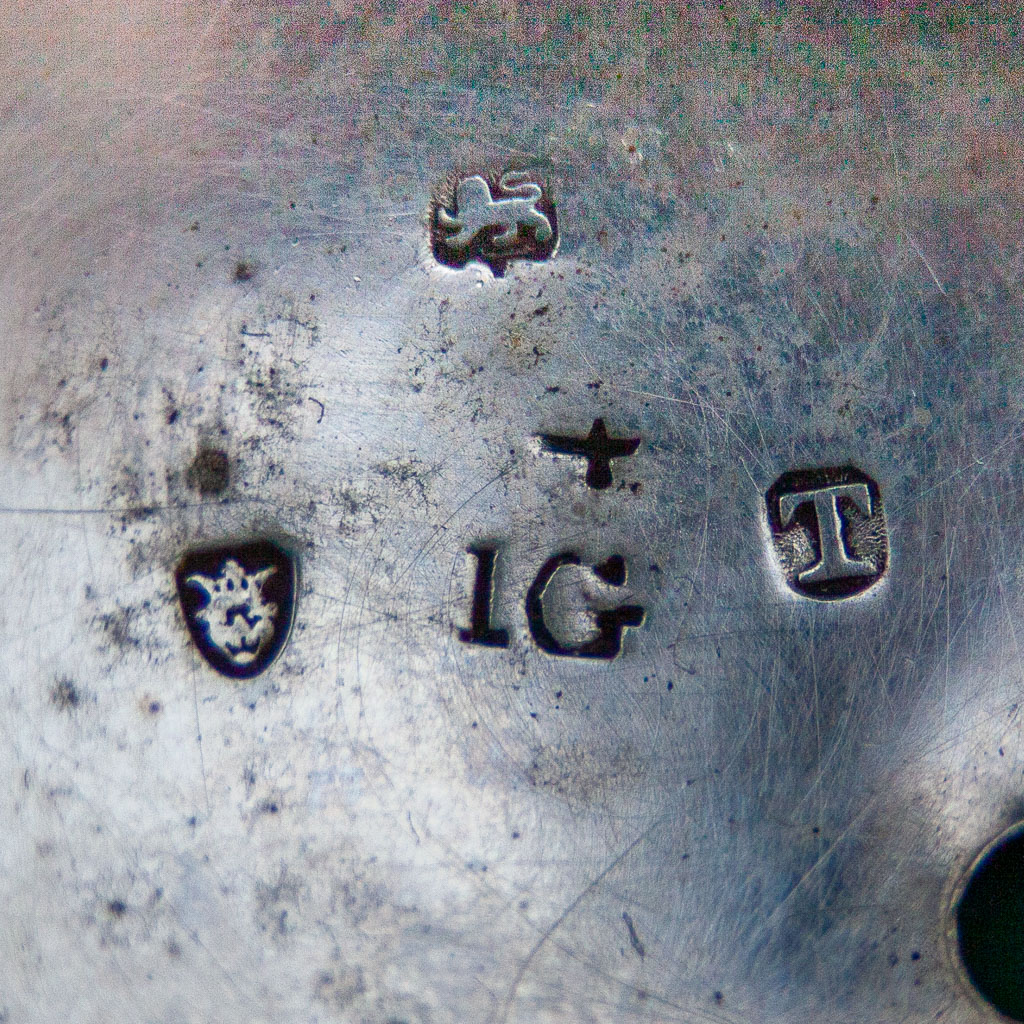
The Five Hallmarks Decoded
- The Exeter Town Mark (Three-Towered Castle)
The arms of the City of Exeter, confirming the case was assayed at the Exeter Assay Office. This makes it "provincial silver"—made outside London—which is much rarer and more collectable than London silver. Exeter served as the assay office for all of Devon and Cornwall. - The Lion Passant (Walking Lion)
The standard mark for sterling silver (.925 purity—92.5% pure silver, 7.5% copper for strength). It was illegal to sell silver in England without this quality control mark. The lion's presence guarantees the case meets the legal standard. - The Duty Mark (Worn King's Head, appears as a cross)
Originally the clear profile of King William IV (reigned 1830-1837), proving the required tax was paid to the Crown. After 190 years and countless polishings, the King's facial features have worn down, leaving mainly deep indentations that can appear as a cross or unclear shape. This mark dates the watch to William IV's reign. - The Maker's Mark "IG"
The registered mark of John Gamon, a specialist watch case maker in Exeter. Gamon would have built the silver cases, taken them to the Assay Office for hallmarking, then sold them to watchmakers like Hambly. - The Date Letter "T"
A capital serif "T" inside a rectangular shield with clipped corners. In the Exeter assay cycle, this specific "T" represents the year 1835. Exeter changed its date letter annually on 7th August, so this case was hallmarked between August 1835 and August 1836—placing it in the final weeks or months of William Hambly's life.
The "Turnip": Pair-Case Design and Practical Engineering
You will immediately notice this watch has two cases—an inner case containing the movement, and an outer protective case. This "pair case" design was not decorative luxury but practical necessity for a working timepiece in 1830s Cornwall.
Why Two Cases?
Dust Protection: Unlike modern watches, this Verge Fusee is wound from the back with a key. Every time you wound it, you had to open the back and insert the winding key directly onto the arbor (shaft) of the fusee. This exposed the delicate mechanism to the environment. In rural Cornwall—with its tin mines, market towns, and agricultural work—dust and grit were constant threats. The outer case protected the inner mechanism from contamination every time the watch was wound.
Impact Protection: The gap between inner and outer cases acted as a cushion, absorbing shocks that would otherwise be transmitted directly to the movement. For a watch that might be worn while riding horses, working at market, or conducting business in rough country, this extra protection was essential.
The "Turnip" Feel: These watches were affectionately known as "turnips" due to their thick, round shape. They were heavy, substantial objects—3-4 ounces of solid silver and brass—that weighed down a waistcoat pocket with reassuring heft. You always knew it was there.
The Sound: A Verge escapement is not quiet. Unlike later lever escapements, the Verge has a loud, rhythmic recoil—a tick-TOCK, tick-TOCK that was clearly audible to the wearer. This "heartbeat" would have been a constant companion to Mr. Copplestone and Mr. Cloke as they went about their days, a mechanical pulse measuring out their hours.
A Paper Trail of Ownership: The Watch Papers
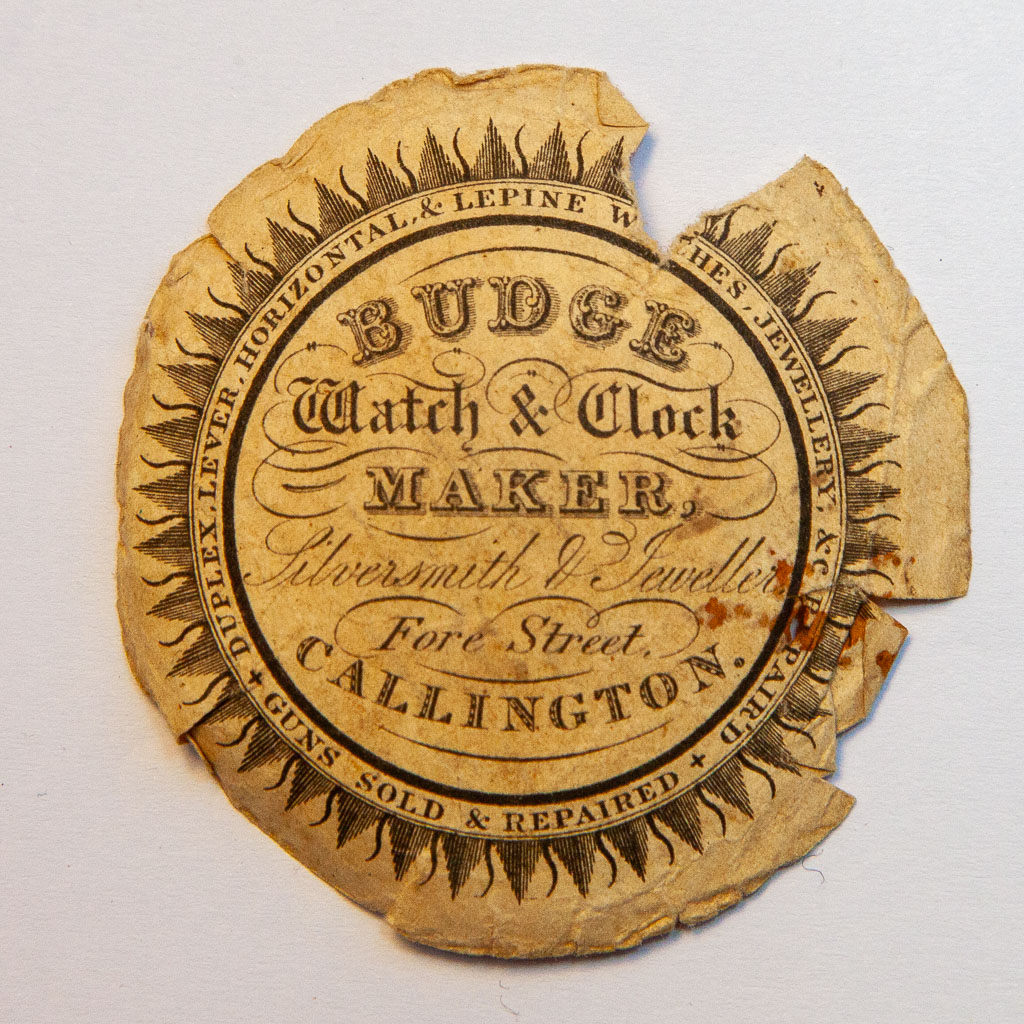
Hidden inside the outer case were several "watch papers"—protective paper liners used to prevent the inner case from rattling against the outer case. These ephemeral scraps of paper, which typically would have been discarded when the watch was next serviced, have survived for nearly 170 years. They double as a service log, preserving a timeline of care spanning five decades.
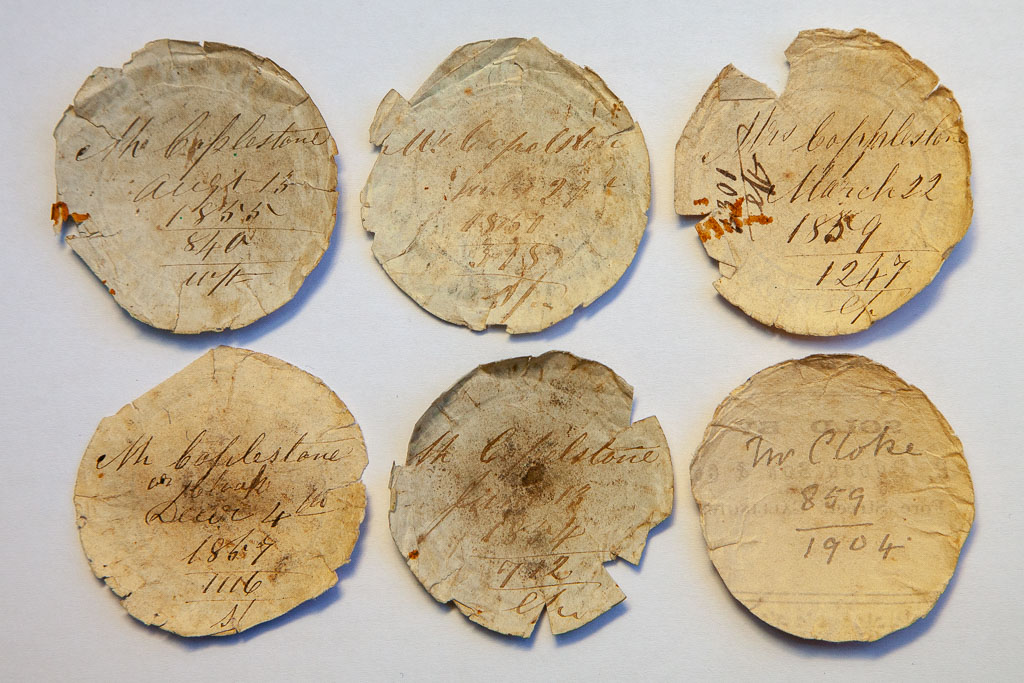
The papers advertise "Budge - Watch & Clock Maker, Silversmith & Jeweller" of Fore Street, Callington—the business that took over servicing watches in Callington after William Hambly's era ended. This succession represents the continuity of local craft: when Hambly died in 1835, Budge's establishment maintained the tradition of watchmaking in the town.
Documented Services: Copplestone Ownership
- 1851 — Service for "Mr. Copelstone" (watch is ~20 years old)
- 1854 — Service for "Mr. Copelstone"
- 1855 — Service for "Mr. Coplestone"
- 1859 — Service for "Mrs. Copplestone"
Note: The variation in spelling was typical of the period when spelling depended on the watchmaker's interpretation of the spoken name.
Cloake Family Ownership
- 1867 — Service for "Mr. Coplestone/Cloak" (John Cloake living at Penyoke also Jane Copplestone)
- 1904 — Service for "Mr. Cloke" (David Thomas Cloake, age 45)
This services mark the watch's passage to next generations and the continued family commitment to maintaining this heirloom.
A Symbol of Substance: What It Meant to Own This Watch in 1835
To fully appreciate this watch's significance, we must understand what it represented in the social and economic world of 1830s Cornwall.
Social Significance in Victorian Cornwall
In 1830s-1850s Cornwall, watches were clearly stratified by class:
- Gold watches = Gentry, wealthy merchants, professionals
- Silver watches like this one = Middle class, prosperous tradesmen
- Base metal watches = Working class who could afford timekeeping
- No watch at all = Agricultural laborers, miners, servants—most of the population
For Richard Copplestone, a tailor in St Mellion, owning this watch was both a practical necessity and a social statement. As a tailor, he needed accurate timekeeping for:
- Managing client appointments and fitting schedules
- Coordinating deliveries and meeting deadlines
- Demonstrating punctuality and reliability—key virtues in business
- Signaling his professional status to clients and competitors
But beyond utility, the watch proclaimed: I am a man of substance. I value precision and order. I have the resources to own quality goods. I am respectable.
Richard Copplestone and the Watch's Early History
The documented service history begins with Richard Copplestone (born 3 August 1777, died September 1857), a tailor working in St Mellion, Cornwall. But how did Richard come to own one of William Hambly's final works?
Possible Origins of Richard's Ownership
Scenario 1: Richard purchased it new or nearly new (late 1830s)Richard married Jane (widow Cloak) on 8 December 1832. He was then 55 years old, an established tailor with a new blended family. Purchasing a quality watch would have been a fitting way to mark this new chapter—a tool for his trade and a symbol of his prosperity. The watch would have come from Hambly's workshop or been purchased shortly after from Hambly's estate or successors. Also the first 1851 cleaning ticket suggest he may have only owned it from the late 1840s. It could have been puchased secondhand or:
Scenario 2: Richard inherited it from his fatherIf Richard's father was also a tradesman or professional, the watch might have passed to Richard as an inheritance. We would need to research Richard's father to explore this possibility.
Scenario 3: Gift or bequest from another sourceThe watch could have been gifted to Richard by a patron, relative, or through some other connection we don't yet know about.
What we know with certainty is that by 1849, Richard Copplestone owned this watch and was having it professionally serviced—maintaining a now 14-year-old timepiece and demonstrating his commitment to preserving it properly.
The Family Connection: Marriage, Inheritance, and Memory
The watch's passage from Copplestone to Cloake is rooted in a marriage that joined two Cornish families and created a bond that would span generations.
The Blended Family
On 8 December 1832, Richard Copplestone (age 55, tailor in St Mellion) married Jane Bennett (age ~52), the widow of William Cloak. Jane brought to the marriage her son, John Cloake, who was then 14 years old (born 31 May 1818).
Richard became John's stepfather, raising him through his teenage years into manhood. This was not a distant or formal relationship—when John married Mary Ann Barrett in 1845 at St Mellion Parish, Richard Copplestone served as witness, a clear indication of the close family bond.
For 25 years (1832-1857), Richard was John's stepfather. When Richard died in September 1857 at age 80, his widow Jane—John's mother—came to live with John's family at Penyoke, Cargreen. The 1861 Census records her as "Jane Copplestone, aged 81, widow," residing with her son, daughter-in-law Mary Ann, and grandchildren.
The watch passed from stepfather to stepson, probably around 1857-1859. The 1867 service for "Mr. Copplestone/Cloak" may have been the last under Jane's lifetime (she would have been 87). After that, the watch became purely Cloake property—but it retained the name "Copplestone" in family memory, a testament to the man who had raised John and left him this tangible legacy.
Five Generations: The Path of Inheritance
1835-1836: Creation
William Hambly assembles and regulates the movement in Callington; John Gamon's silver case is hallmarked at Exeter; the complete watch enters the world in the final months of Hambly's life
By late 1830s: Richard Copplestone acquires the watch
Richard (b. 1777, tailor in St Mellion) owns the watch through purchase, inheritance, or gift; uses it for his tailoring business and as a symbol of professional respectability
1851-1867: Regular maintenance
Richard has the watch serviced regularly at Budge's in Callington—1851, 1854, 1855, 1857; the watch is approximately 20-30 years old during this period and being carefully maintained
September 1857: Richard Copplestone dies
Age 80; his widow Jane continues to live, first independently, then with her son John's family at Penyoke
1857-1867: Transition period
The watch likely passes to John Cloake (Richard's stepson) around 1857-1859, but may have been held "in trust" by Jane; the 1859 service for "Mrs Copplestone" might refer to John acting on behalf of his mother's household
September 1863: Jane Copplestone dies
Age ~83; the watch is now definitively John Cloake's property. The 1867 service for "Mr. Coplestone/Cloak" makes sense of this
September 1900: John Cloake dies
Age 82, in St Germans; the watch passes to his son David Thomas Cloake
1904: David Thomas Cloake's service
"Mr. Cloke" (David Thomas, age 45) has the watch serviced at Budge's—the first documented service in 37 years; David was a bargeman who later became a farmer, owning Warren House and a 90-acre farm
1940: David Thomas Cloake dies
Age 81, in St Germans; the watch continues through subsequent generations
Early-20th century: Journey to New Zealand
The watch travels from Cornwall to Canterbury, New Zealand, with emigrating family members, maintaining its connection to family history across 12,000 miles
2025: Mervyn Cloake
Current custodian of William Hambly's 190-year-old masterwork, preserving five generations of family memory in silver and brass
Why This Watch Was Never Sold
Perhaps the most remarkable aspect of this watch's story is its survival. Consider what it lived through:
- The agricultural depressions of the 1870s-1880s
- The decline of Cornish tin mining
- John Cloake's modest circumstances as an agricultural labourer
- David Thomas Cloake's early years as labourer and bargeman
- The hardships of the First and Second World Wars
- The great emigrations from Cornwall to the New World
- Economic depressions and personal hardships
At any point, this watch could have been sold. Its silver content alone represented significant value—enough to feed a family for months or pay rent for a year. Yet it was preserved.
Why? Because it was worth more than its silver. It represented:
- Richard Copplestone's legacy to his stepson John—a tangible reminder of the man who raised him
- Professional identity—the link to Richard's respectable trade and middle-class status
- Family continuity—the physical object connecting John to his stepfather, David Thomas to his father, and subsequent generations to their Cornish roots
- Quality and craftsmanship—William Hambly's last work, maintained for 190 years
- The sound of home—that loud Verge tick-TOCK that John heard at Penyoke, that David Thomas heard at Warren House, carried forward in memory
From Callington to Canterbury: The Emigrant's Heirloom
At some point in the 20th century, this watch made one final journey—from Cornwall to New Zealand. The Cloake family's emigration to Canterbury represents the broader story of Cornish migration, as thousands left the declining mining regions and agricultural hardships of Cornwall for opportunities in the New World.
What items do you bring when you emigrate? You can't bring everything. Space on ships was limited, costs were high, and you had to choose what was essential. Yet someone chose to bring this watch—90 or 100 years old by then, no longer fashionable, a "turnip" from a bygone era.
They brought it because it was memory made tangible. The watch that Richard Copplestone wore to John's wedding. The watch John wound each morning at Penyoke. The watch David Thomas carried while working the barges, then farming his 90 acres. The watch that ticked out the hours of family gatherings, christenings, funerals, and ordinary days.
That watch—William Hambly's last work—traveled 12,000 miles to become a New Zealand treasure, forever linking the Cloake family to a Callington workshop that closed in 1835.
The Watch in 2025: A Living Connection
Today, in Mervyn Cloake's care, this watch continues to fulfill its purpose—not to keep perfect time, but to keep memory.
When wound with its original key, the movement still runs. The Verge escapement's loud tick-TOCK still sounds—the same rhythm that Richard heard in his St Mellion workshop, that John heard at Penyoke, that David Thomas heard at Warren House. Across 190 years, the sound remains unchanged.
And now we can tell its story on this family website page for all to share and appreciate.
The watch has outlived:
- William Hambly's workshop (closed 1835)
- Budge's watchmaking business in Callington
- John Gamon's silversmithing in Exeter
- The Exeter Assay Office itself (closed 1883)
- The entire Verge Fusee era of watchmaking
- Five generations of owners
Yet it endures—proof of William Hambly's skill, John Gamon's craftsmanship, and five generations' commitment to preserving family memory.
Historical and Genealogical Significance
This watch is remarkable on multiple levels:
- Precisely dated provincial craftsmanship — The hallmarks date it to a single year (1835), and William Hambly's death in October 1835 makes it one of his last works. This precision is rare for family heirlooms.
- Complete documentation — From manufacture (1835) through services (1849-1904) to present ownership (2025), we can trace this watch through 190 years with unusual completeness.
- Manufacturing history — The watch illustrates the 19th-century supply chain: Lancashire movements, Exeter cases, Callington finishing. It's a case study in provincial craft networks.
- Social history — The watch documents middle-class aspiration and family values in Victorian Cornwall. Richard's ownership of a £5-7 watch reveals his social status; the family's preservation of it across hardships reveals its symbolic value.
- Family relationships — The watch's passage from stepfather (Richard) to stepson (John) to grandson (David Thomas) maps family bonds across three generations, crossing the boundary from Copplestone to Cloake while retaining memory of both families.
- Emigrant heritage — As an object that traveled from Cornwall to New Zealand, the watch represents the tangible threads connecting emigrant communities to their ancestral homeland.
- Technological artifact — As a Verge Fusee watch, it represents an obsolete but historically important technology—the last generation before the lever escapement revolution transformed watchmaking.
For Future Generations
If you are reading this as a descendant of the Cloake family, you are now the custodian not just of a watch but of 190 years of documented history. Some suggestions for preservation:
- Never clean or polish the case — The patina and wear patterns are part of its history
- Store it safely — Away from extreme temperatures and humidity
- Wind it occasionally — Let the mechanism move to prevent oil from congealing
- Keep the watch papers — These fragile documents are irreplaceable
- Document the story — Add your own memories and knowledge to this record
- Consider professional conservation — If the watch needs work, consult a specialist in antique watches, not a modern jeweler
Acknowledgments and Research Notes
Primary Sources:
- The watch itself and its hallmarks
- Original watch papers (1849-1904)
- Family GEDCOM genealogical records
- UK Census records (1841-1911)
- Parish marriage records (St Mellion)
Further Research Opportunities:
- William Hambly's complete business history and other surviving works
- John Gamon's output and business records in Exeter
- Budge's business succession and records in Callington
- Richard Copplestone's tailoring business and client base
- The watch's journey from Cornwall to New Zealand (which family member, when, under what circumstances)
If you have additional information: Please contact the family historian. We particularly seek information about how the watch passed through the 20th century from David Thomas Cloake (d. 1940) to Meryn, and about the specific circumstances of its journey to New Zealand.
Article researched and compiled 2025. Special thanks to Mervyn Cloake for preserving this watch and its documentation, and for making this research possible.