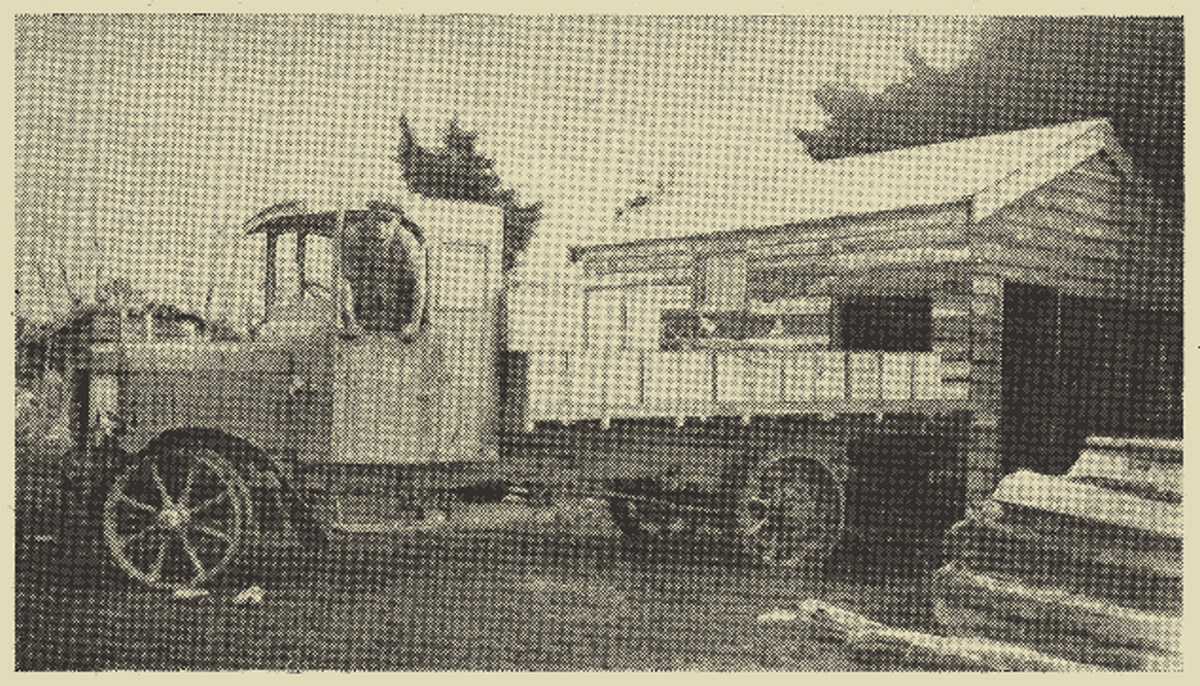
Born for the Front Lines: The “RAF-Type” Leyland
During the First World War, Leyland Motors in Lancashire manufactured over 5,000 heavy-duty Class 'A' lorries for the British War Office, serving with the Royal Flying Corps (RFC) and the Royal Air Force (RAF). Operating in the mud, shell holes, and ruined pavé roads of the Western Front, they earned an unmatched reputation for near-indestructible engineering.
When the war ended in 1918, thousands of these rugged lorries sat in vast military surplus depots like the famous Slough vehicle dump in England. Rather than letting their reputation be ruined by neglected surplus sales, Leyland took an extraordinary step: they bought back thousands of their own ex-service chassis, brought them back to the factory, stripped and rebuilt them to original manufacturing standards, and re-sold them with an official warranty.
A large contingent of these rebuilt veterans—as well as newly built civilian models sharing the identical War Department chassis specification—were exported across the British Empire, landing in New Zealand through the 1920s to power the country’s expanding road transport sector.
Anatomy of an Early Canterbury Heavy Lorry
Several distinct hallmarks reveal this truck’s lineage:
-
The High-Shouldered Cast Radiator: The unmistakable cast-aluminium header tank, curved at the top and bolted with sturdy fluted side columns to an exposed matrix core, proudly wore the embossed LEYLAND nameplate.
-
War Office Chassis & Crank Bracket: Below the radiator sits the heavy front cross-channel featuring the perforated drop-bracket that guided the engine starting handle—a signature War Office detail designed for rough recoveries and heavy crank-starts.
-
Hollow Cast-Steel Artillery Wheels: Long before pneumatic tyres became standard for heavy loads, these trucks ran on massive cast-steel spoked wheels shod with bands of solid vulcanised rubber (single tyres on the steering axle, wide dual bands on the driven rear). On gravel river crossings, rutted unsealed roads, or wet paddock turf, they shook the teeth of anyone inside, but they never got a puncture.
-
Locally Built Wooden "C-Cab": Most commercial chassis arrived in New Zealand as bare running gear (engine, gearbox, bonnet, and scuttle cowl). Local coachbuilders framed and built the timber cabs to suit local requirements. Bertie’s lorry features a classic high-roofed wooden C-cab, built high over the scuttle to clear the gravity-fed petrol tank and provide a commanding view down rural lanes.
From the Horse-and-Dray to Motor Power
When Bertie first began beekeeping in South Canterbury around the Winchester, St. Andrews, and Mackenzie Country districts, beekeeping was still firmly in the "horse and spring cart" era. Moving heavily laden supers of comb, extractor equipment, and dozens of stinging hives with a horse team was fraught with danger—one bad sting could bolt a horse and scatter a season's work across the shingle.
Upgrading to a 3-ton Leyland transformed what an apiarist could accomplish. With its expansive timber flatdeck, the Leyland could shift dozens of hives in a single evening or haul tons of boxed honey directly from out-apiaries back to Springbrook for packing and processing.
Standing high in the cab doorway, cap tilted back, this photograph captures a defining transitional moment: a veteran British wartime workhorse giving second life to rural industry on the Canterbury Plains.